Mechanics, nurses, engineers and other professionals are required to receive certifications to prove they have the necessary chops to perform their jobs. Shouldn’t the products they use also pass a certification process?
UL ratings were designed to do just that. Products like lights, heaters and even
cable ties are put through the rigorous UL certification process every day, with the goal of proving their safety for both workers and customers.
Below, we dive into the most frequently asked questions about UL certifications, the approval process, UL ratings and more.
9 Frequently Asked Questions About UL Certification
- What is UL?
- Why is UL Approval Important?
- Why Should I Buy UL-Approved Products?
- How Are Products Tested by UL?
- Is UL Certification Required by Law?
- What Are the Different Types of UL Certifications?
- How Are UL and OSHA Connected?
- What is UL-Certified Monitoring?
- What is the Difference Between CE and UL?
1. What is UL?
Since 1894,
Underwriters Laboratories (UL) has performed product safety testing with the goal of improving employee and consumer safety. You’ve likely seen a UL logo on one of your home appliances, but it is used to test many different categories of products.
As an independent, third-party, non-profit organization, UL has no stake in the products they test. Their seal of approval, therefore, is unbiased.
UL approval offers assurance that the safety and performance claims behind a product have been thoroughly verified by a third party. UL is also an accredited standards developer in the U.S. and Canada, setting industry standards for manufacturers that innovate new products. To date, UL has developed over 1,500 standards.
2. Why is UL Approval Important?
As technology evolves, the need for uniform safety and implementation standards for new products becomes increasingly critical. The UL certification process attempts to prove manufacturer competency, ensures that a product is safe and brings to light any potential hazards related to that product.
UL approval is especially important for electrical products. These listings provide businesses and consumers with guidelines that help keep everyone safe when installing electrical wire, using a battery or working with a product that could be harmful if not handled correctly.
3. Why Should I Buy UL-Approved Products?
While it may be tempting to purchase cheaper, non-UL approved products from overseas manufacturers, you may end up paying for it in the long run. There’s no guarantee that products from overseas have gone through as rigorous an approval process as a UL-certified product, which could lead to detrimental safety or performance issues.
4. How Are Products Tested by UL?
The UL testing process includes the certification of personnel, products, facilities, processes and systems. Testing is performed by support associates, field representatives, engineers and technical support professionals.
For products to become UL-certified, manufacturers submit representative samples that are then assigned to a specific category based on the product’s intended use. From there, the appropriate standards a product must meet in order to become approved are defined, and the UL team executes their testing process.
This process includes:
- Examining the construction of the product
- Performing tests with the product in use
- Analyzing the results of the product’s performance
Once certified, UL continues to monitor and test the product. Field representatives may show up to a facility unannounced, and will take away a product’s certification if necessary.
“It is easier to design a product with UL requirements in mind than to redesign a product to meet a set of requirements.” – UL
5. Is UL Certification Required by Law?
No, there currently is no law that requires products to be approved by UL.
However, in many manufacturing and service applications, there may be specific codes that require the use of UL-recognized products.
6. What Are the Different Types of UL Ratings?
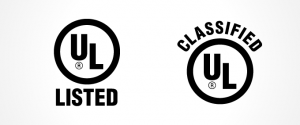
There is no general UL certification. Instead, there are three different categories: UL Recognized, UL Listed and UL Classified.
What Does it Mean to be UL Recognized?

This applies to components that are used to produce other products. It means that the product is safe and ready to use, but it’s not a seal of approval for the end product.
A UL-Recognized seal can be found on components like power supplies, circuit boards, and other items in factories and manufacturing facilities. End consumers don’t traditionally have a need for UL-Recognized components.
What Does it Mean to be UL Listed?
This certification is probably more recognizable, as it applies to consumer-ready products like:

- Appliances
- Computer equipment
- Bulletproof glass
- Furnaces and heaters
- Smoke and carbon monoxide alarms
- Fire extinguishers
Since these are finished products, the UL Listing process involves more comprehensive testing than the UL Recognition process.
There are many different types of products that can be UL Listed — so many, in fact, that UL has created categories. Here are a few examples:
- UL 153 standardizes safety measures for portable lamps
- UL 110 standardizes safety measures for mobile phones
- UL 1995 standardizes safety measures for heating and cooling products
What is UL Classification?

UL Classification sets standards that are specific to each product.
According to UL, classification marks “appear on representative samples of products that UL has evaluated with respect to specific properties, a limited range of hazards or suitability for use under limited or special conditions.”
7. How Are UL and OSHA Connected?
American employers are required by law to follow the rules set forth by the
Occupational Safety and Health Administration (OSHA). UL works with OSHA to perform safety testing and recommend safety equipment that must be provided to employees.
For example, UL was the first to recommend that fire extinguishers be provided by employers and they established tests to verify that fire doors are working at all times.
8. What is UL-Certified Monitoring?
This includes security and fire monitoring systems. UL-listed commercial entities, known as central stations, are required to follow the requirements of UL 827.
9. What is the Difference Between CE and UL?
CE is also known as
Conformité Européenne, which is French for “European Conformity.”
CE is similar to UL, but for products sold in the European Union. Unlike UL, the CE mark is required for certain products, like medical devices, gas appliances, machinery and others.
Checking UL certifications is one of the best ways you can vet products. Employees will rest assured knowing that they are working with safe components and customers will have peace of mind that their products have been thoroughly tested.


 This applies to components that are used to produce other products. It means that the product is safe and ready to use, but it’s not a seal of approval for the end product.
A UL-Recognized seal can be found on components like power supplies, circuit boards, and other items in factories and manufacturing facilities. End consumers don’t traditionally have a need for UL-Recognized components.
What Does it Mean to be UL Listed?
This certification is probably more recognizable, as it applies to consumer-ready products like:
This applies to components that are used to produce other products. It means that the product is safe and ready to use, but it’s not a seal of approval for the end product.
A UL-Recognized seal can be found on components like power supplies, circuit boards, and other items in factories and manufacturing facilities. End consumers don’t traditionally have a need for UL-Recognized components.
What Does it Mean to be UL Listed?
This certification is probably more recognizable, as it applies to consumer-ready products like:
 UL Classification sets standards that are specific to each product. According to UL, classification marks “appear on representative samples of products that UL has evaluated with respect to specific properties, a limited range of hazards or suitability for use under limited or special conditions.”